.png&w=3840&q=75)
Parental Transitions at Work: A Structured Approach to Supporting Employees Across the Lifecycle
Introduction: Why parental transition is a workplace priority
Parental transitions represent a crucial inflection point in the employee lifecycle at work. It is a key workplace priority as it impacts career progression, gender representation, and workforce participation. The McKinsey Women in the Workplace report (2025, Alexis Krivkovich, Drew Goldstein and Megan McConnell) highlights that as women advance onwards in the corporate pipeline, attrition is seen at the early and mid-level stages.
These attrition patterns are closely linked with key life stage transitions such as parenthood. During this stage, caregiving responsibilities often collide with workplace challenges, unmet expectations, and career continuity. Additionally, a lack of parental transition related support (flexibility and structured support) can lead to employees, particularly mothers, to reduce working hours or exit from the organisation altogether.
Reintegration support, flexibility, and equitable career opportunities enable employees to stay and advance in their careers.
What are parental transitions in the workplace?
Parental transitions refers to the journey employees experience before, during, and after taking parental leave whether due to birth, adoption, or surrogacy.
Effective parental transitions seek to address the below:
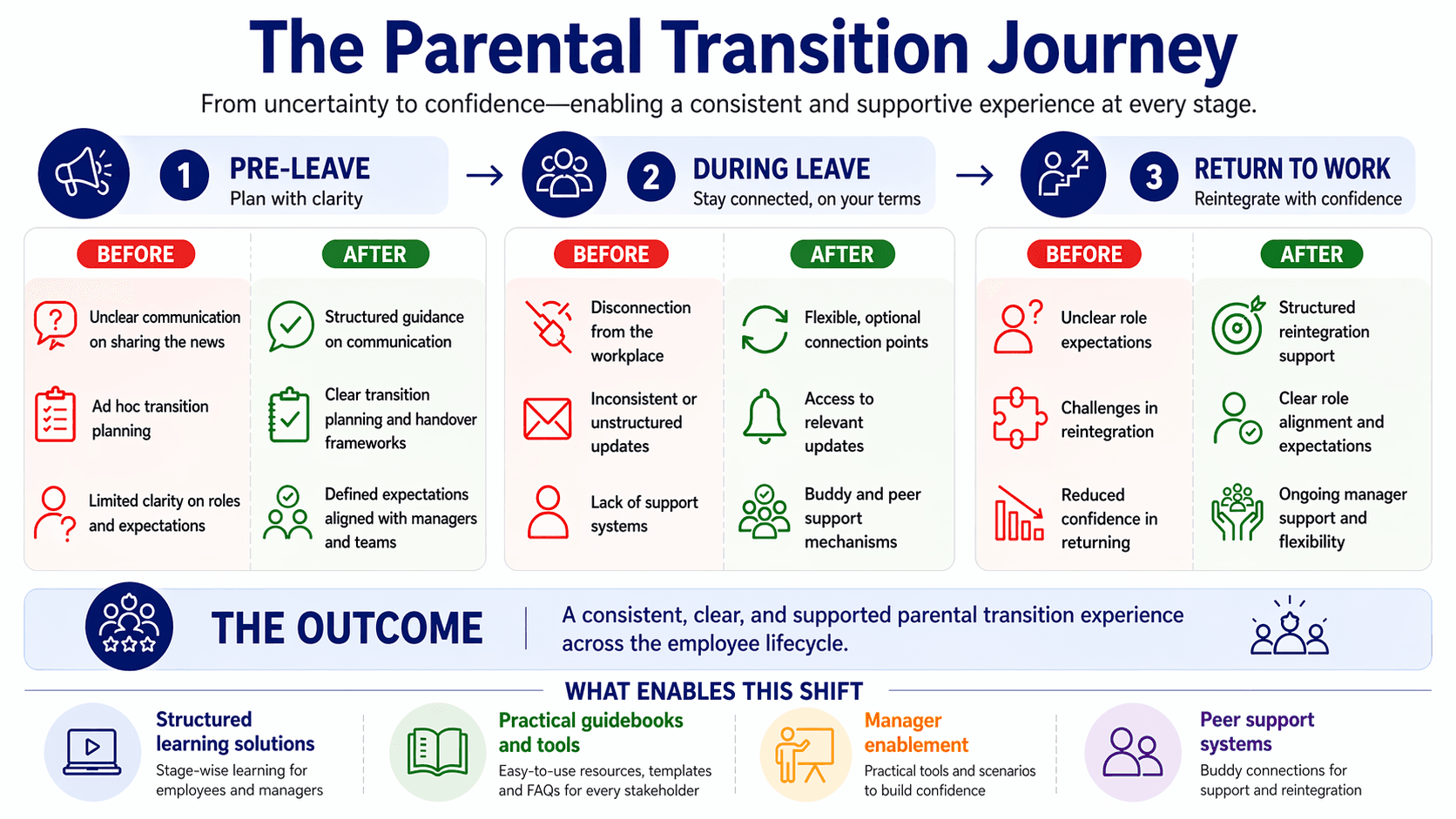
Pre-Leave Planning: Reducing Uncertainty Through Structured Guidance
Prior to availing of parental leave, employees often face challenges related to communication, role continuity, and meeting manager expectations. A lack of structured guidance can lead to informal approaches and conversations that lead to misalignment, confusion, and burnout within teams.
At the pre-leave planning stage, structured guidance can enable employees to:
- Communicate parental transitions effectively
- Plan and allocate work responsibilities before going on leave
- Meet manager and stakeholder expectations
Employee feedback:
“I was anxious and not sure about how I could share my news..”
During Leave: Enabling Connection While Respecting Flexibility
During parental leave, employees may require differential support including varying levels of engaging and communicating with the organisation. In the absence of clear guidelines, a certain disconnect can be experienced impacting employee confidence and role continuity.
A structured support system includes:
- Manager check-ins and optional communication
- Team updates that ensure a positive experience throughout
- Peer or buddy support
Employee feedback:
“It helped me to think about how I could plan my support system while on leave so that I could plan a smooth return to work.”
Return to Work After Parental Leave: Supporting Reintegration and Confidence
The return to work phase is a crucial stage for the employee. Employees often navigate caregiving responsibilities along with team expectations in this stage. It can impact confidence and role continuity in the absence of reintegration support.
Providing reintegration support can enable employees to:
- Clearly comprehend role expectations
- Transition back to work flexibly
- Re-engage with teams confidently
Employee feedback:
“The support I got from my manager helped me to plan my return from maternity much better in a phased manner.”
Manager Support During Parental Transitions
Managers have to plan for parental transitions, manage workloads, and empathetically handle conversations.
Therefore, it becomes crucial for managers to be equipped with practical tools and scenario based guidance to address challenges.
Manager feedback:
“I was unsure how to respond to my team members when they shared they were pregnant and how to plan the transition.”
Our Solutions to Support Parental Transitions at Work
More than isolated interventions, organisations can benefit from a structured parental transition system that equips managers, employees and even buddies.
Below are enablers that create a cohesive parental transition ecosystem at work:
Building Awareness and Capability Through Training
Our parental transitions e-learning modules and virtual workshop for buddies provide guidance on navigating workplace dynamics for employees, managers and buddies. Particularly, it focuses on pre, during, and return to work phases.
Through practical tools and scenario based learning, the training provides actionables that can be applied in real workplace situations.
Enabling Consistency Through Practical Resources (Guidebooks)
Guidebooks for employees, managers, and peer supporters/ buddies provide structured step-by- step guidance across the parental transition lifecycle. Communication templates, FAQs, and scenario based reflections ensure that there is certainty and consistency across teams.
Strengthening Buddy Systems through Peer Connection
Buddy systems focus on a peer based layer of support that enriches and complements formal structures. Peer to peer based connection can be focused upon during parental leave and act as additional support during reintegration
Conclusion
Parental transitions require multiple stage based support across the parental lifecycle. A structured, lifecycle based approach focuses on practical tools, manager enablement, and inclusive practices. Across pre-leave, during leave, and return-to-work phases, organizations can enable smoother transitions while maintaining continuity and alignment across teams.
#ParentalTransitions #EmployeeExperience #InclusiveWorkplaces #WomenInLeadership #WorkingParents #ReturnToWork #GenderEquity #HRStrategy #EmployeeWellbeing #FutureOfWork
- By Sandra Sebastian, Interweave Consulting Pvt. Ltd.